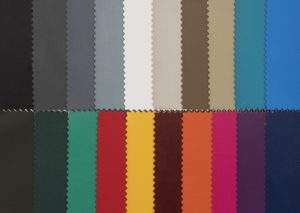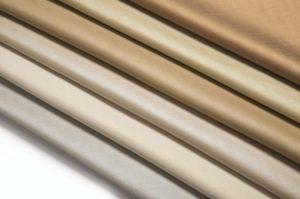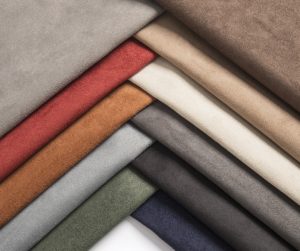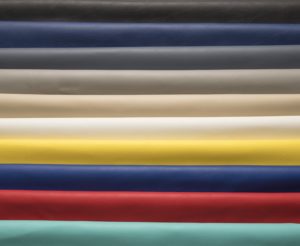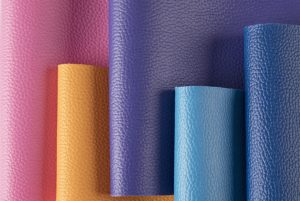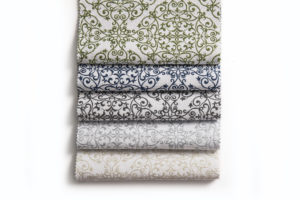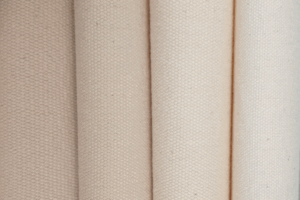
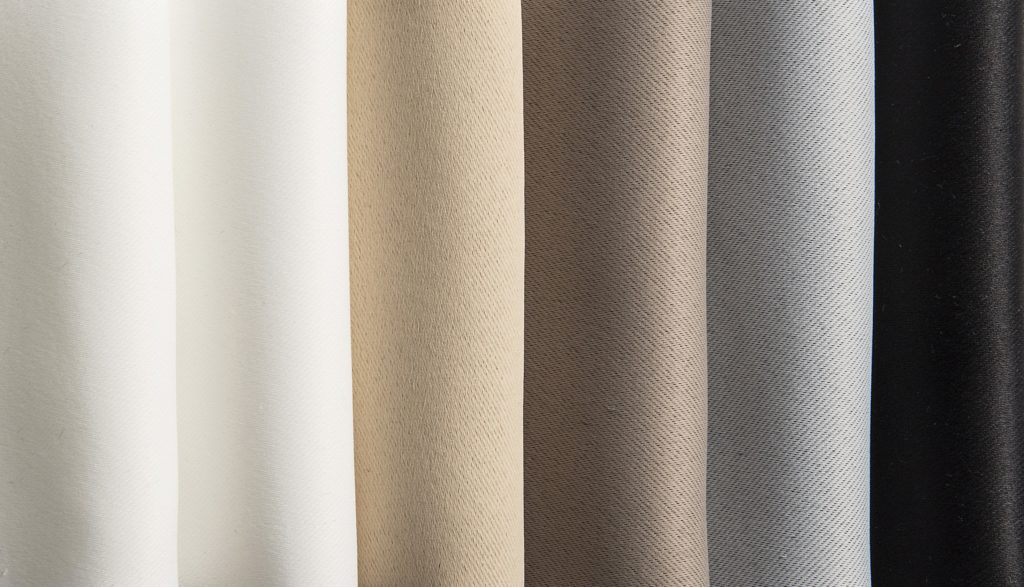
Curtain lining protects and insulates, block-out fabric stops light, and backing puts that coating straight onto the face fabric.
If you’re weighing up block-out curtain lining against plain lining and coated curtaining, you’re really choosing how to handle three things: light, heat and fabric wear. The names get muddled, even in the trade. This guide explains what curtain linings are, what pass counts mean and which option suits each room: the same advice we give across the counter, minus the queue.Contents
- The three options side by side
- What curtain lining does
- Block-out explained: 1-pass, 2-pass and 3-pass
- Thermal linings and when they earn their keep
- Which to choose for each room
- How many metres of lining do you need?
- Care and common problems
- Try before you buy
- Resources
- FAQ
The three options side by side
Most of the confusion clears the moment the three products sit side by side. Each one earns its place in our ranges; they simply solve different problems.| Plain curtain lining | Block-out fabric | Coated backing | |
| Light blocked | Softens and dims | Essentially all, with 3-pass | Depends on the passes applied |
| Insulation | Moderate: adds a trapped-air layer | Good: the coating resists heat flow | Good, in a single layer |
| Drape | Excellent: adds weight and fullness | Very good behind a face fabric | Firmer hand, flatter folds |
| Protects face fabric? | Yes: it takes the sun first | Yes, when hung as a lining | Partly: coating and face are one cloth |
| Separate or coated? | Separate cloth, sewn or hooked behind | Either a lining or a self-coated curtain | Coating bonded to the face fabric |
| Price band | Most affordable per metre | Mid-range | Varies with the face fabric |
| Best for | Everyday protection and drape | Dark bedrooms, nurseries, shift-sleepers | One-layer simplicity, ready-made styles |
What curtain lining does
Hang an unlined curtain on a sun-struck window and the countdown starts: the South African sun fades dyes, weakens fibres and rots hems long before the fabric owes you anything. That is why curtain lining fabric in South Africa is less a finishing touch than an insurance policy.- Protection: the lining takes the UV, so your face fabric keeps its colour and strength.
- Drape: the extra layer adds weight, so curtains hang in full, even folds rather than limp panels.
- Insulation: the trapped air between the two cloths slows heat moving through the window.
- Retail Sales Consultant, Kehls Cape Town
Block-out explained: 1-pass, 2-pass and 3-pass
Pass counts sound technical; they are simply a tally. A block-out cloth starts as a woven base, and the mill applies one, two or three layers of foam or acrylic coating: each layer is one pass.1-pass and 2-pass: dim-out territory
A 1-pass cloth takes the glare off without full darkness, which suits lounges and offices. A 2-pass blocks noticeably more, though a bright morning will still glow through faintly. The trade often calls these dim-out rather than block-out.3-pass: the full block
Three coating layers, with a light-blocking middle layer (often black) sandwiched inside. That hidden layer is why 3-pass stops essentially all light through the fabric itself, and why it is the standard wherever a genuinely dark room is the brief. Light can still sneak around the edges of a curtain, so generous overlaps help the fabric finish the job.Myth: block-out lining is black. Reality: the dark layer hides in the middle; the faces are usually white or ivory. White faces keep every window looking uniform from the street and reflect sunlight rather than absorbing it, which is why white lining remains the default.One naming note: overseas retailers say blackout curtain lining, South Africa’s trade says block-out, and some suppliers write blockout lining. All three describe the same coated cloth. You’ll find it in our block-out fabric range, used either behind a decorative face fabric or as a self-coated curtain in its own right.Eyelet curtains? No problem. A separate block-out lining hooks or tapes behind the face fabric, so you can darken a room without replacing curtains you already love.Thermal linings and when they earn their keep
Windows leak heat in both directions, and thermal curtain lining slows the traffic. An insulating layer, or a brushed and coated construction, keeps warmth in through winter and pushes back against summer heat gain. In a load-shedding winter, when the heater cannot simply run all evening, lined curtains earn their keep fast.There is useful overlap here: the same coatings that stop light also resist heat flow, so a coated block-out lining often does thermal duty at no extra effort. If insulation is the main goal, say so at the counter and the team will point you to the most insulating constructions in our ranges, all cut by the metre.Which to choose for each room
Scenario snapshot: a night-shift nurse in Pinetown needs to sleep from 09:00. A decorative face fabric with a 3-pass block-out lining turns her east-facing bedroom from glowing to properly dark, while the lining quietly protects the fabric she chose for its looks.- Main bedroom: a 3-pass block-out lining behind your chosen face fabric: darkness, drape and protection in one decision.
- Nursery or shift-sleeper’s room: the full 3-pass, no compromise. Daytime sleep needs the darkest room the fabric can give.
- Lounge: plain or thermal lining. You want colour protection and body here, with the block-out saved for sleeping spaces.
- Kitchen: lighter, washable cloth and good ventilation serve better than heavy coatings next to steam and cooking.
- Sales Consultant, Kehls Pinetown
How many metres of lining do you need?
The arithmetic is friendlier than it looks, because South African décor fabric typically comes on a standard 140cm roll. Four steps get you there.- Fullness: multiply your track or pole width by 2 to 2.5; that multiple gives curtains their gathered body.
- Widths: divide the result by the 140cm roll width and round up to whole widths.
- Drop: take the finished length and add hem and heading allowances, commonly 20cm to 30cm in total.
- Metres: multiply widths by drop for the face fabric, then buy marginally less lining, because lining cuts slightly narrower and shorter.
Care and common problems
Lining problems are nearly always age and environment rather than fabric faults, and most have simple answers.- Yellowing or flaking coating: years of UV slowly yellow a coating, then turn it brittle until it flakes (“disintegrates”, as customers put it). The coating has served its term; because lining hangs as a separate cloth, you replace the lining and keep the curtains.
- Mould on coastal windows: humid coastal air, from Maitland to the KZN coast, encourages mould behind closed curtains on cold glass. Open curtains daily, ventilate the room and treat marks early with gentle cleaning.
- Ironing block-out: keep the iron cool and work from the uncoated side, since high heat can mark the coating. Hanging plus a light steam usually beats pressing altogether.
Try before you buy
Fabric decisions are easier with the cloth in your hands. Order free fabric samples, feel the difference between a plain lining and a 3-pass block-out curtain lining, and hold each against your own window light before you decide.Since 1970 we’ve supplied affordable and quality fabric to the Upholsterer, Motor Trimmer and Public alike. Pop in-store at your nearest Kehls branch in Cape Town (Maitland), Pinetown or George, WhatsApp the branch, or contact us for samples and a quote; if you’re in and around Cape Town, delivery is free from Monday to Friday. Still deciding what curtain linings your rooms need? Bring your window measurements and we’ll work it out together at the counter.Resources
- U.S. Department of Energy, Energy Saver: Energy Efficient Window Coverings. https://www.energy.gov/energysaver/energy-efficient-window-coverings
- Victoria and Albert Museum: Caring for Your Textiles. https://www.vam.ac.uk/articles/caring-for-your-textiles
- Wikipedia: Blackout (fabric). https://en.wikipedia.org/wiki/Blackout_(fabric)