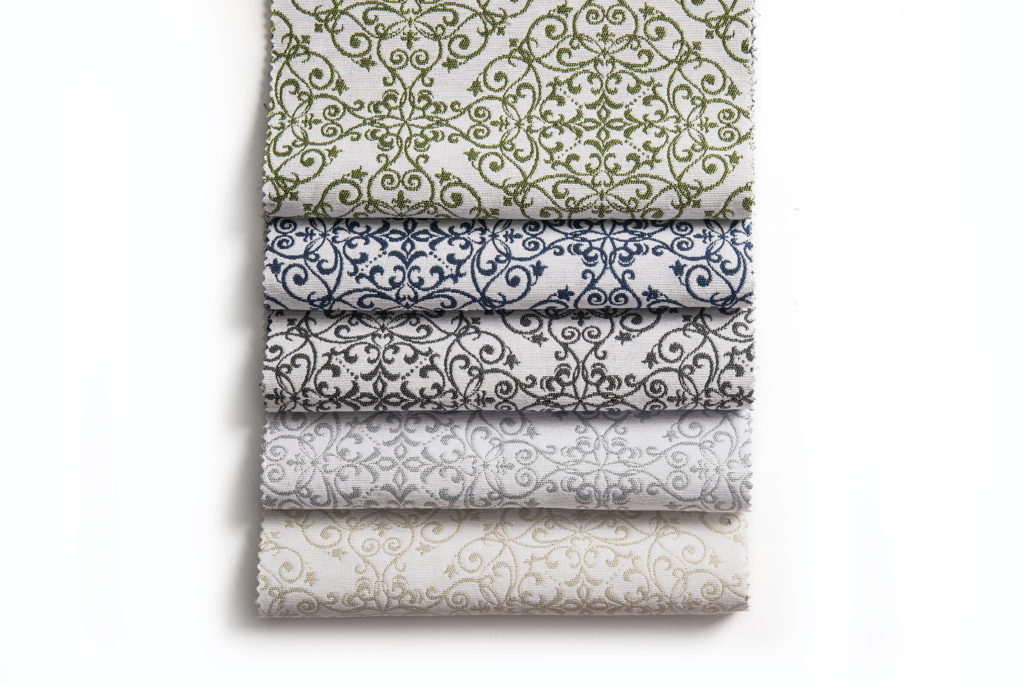
Jacquard is a weaving technique, not a fibre. Damask, brocade and tapestry all have the pattern woven in, so it never washes off.
That’s the short version. The longer one is worth a few minutes, because the questions we hear most at our counters are what is jacquard fabric, whether it lasts on a sofa, and how jacquard vs damask plays out when you’re choosing between two rolls. This guide answers all of it in plain language, with free fabric samples waiting at the end if you’d rather judge by hand.
Contents
- What is jacquard fabric?
- The jacquard family tree
- Jacquard vs damask vs tapestry vs brocade
- Is jacquard fabric good for upholstery?
- Pattern repeat: the buying implication
- Caring for woven decorative fabrics
- See the weave up close
- Resources
- FAQ
What is jacquard fabric?
Jacquard is a technique, not a material. The jacquard fabric meaning is simple: any cloth whose pattern is woven directly into the fabric on a jacquard loom, rather than printed onto the surface afterwards.
The name comes from Joseph Marie Jacquard, who introduced his punched-card loom attachment in Lyon, France in 1804, as Encyclopaedia Britannica records. The cards told the loom which threads to lift for each row, and the idea proved influential enough that Charles Babbage borrowed punched cards for his early computing designs. The fabric on your wingback chair shares an ancestor with the computer in your pocket.
How is jacquard fabric made?
The jacquard mechanism controls warp threads individually, lifting some and lowering others so the design forms as the cloth is woven. Because the pattern goes right through the material, a jacquard weave fabric shows its design on the reverse as well.
That’s the practical difference that matters to a buyer. A printed pattern sits on the surface, where it can fade or wear; a woven pattern is the surface, so it cannot wash off or wear away the same way. Fibre content is a separate question entirely, and our guide to cotton, polycotton and synthetic upholstery fabrics covers that side.
Myth: jacquard is a type of fibre, like cotton or silk. Reality: jacquard describes how a cloth is woven, not what it’s made of. Comparing jacquard fabric vs cotton, or jacquard vs silk, is comparing a “how” with a “what”: a cotton jacquard is both at once, and so is a silk one.
Woven vs knitted jacquard
Nearly all décor jacquard is woven, but knitted jacquard exists too: the pattern is knitted in rather than woven, giving a stretchier cloth used mainly for clothing. Apparel jacquard (dresses, ties, knitwear) is a fine thing in its own right, but it sits outside this guide; everything below is woven décor cloth.
The jacquard family tree
Damask and brocade are not rivals to jacquard; they’re its children. The main jacquard fabric types you’ll meet in décor are damask and brocade, with tapestry standing alongside as the heavier, motif-led cousin. Labels like damask jacquard fabric or brocade jacquard fabric simply confirm the cloth is a jacquard weave of that style.
| Fabric | What it is | How to recognise it |
| Jacquard (the parent) | Any cloth with the pattern woven in on a jacquard loom | Turn it over: the design shows on the reverse |
| Damask | A jacquard weave with a subtle tone-on-tone pattern, typically reversible | Satin and matt areas that trade places as the light moves |
| Brocade | A jacquard weave with raised, often multicoloured designs | Motifs you can feel; generally not reversible |
| Tapestry | A heavier, densely woven pictorial or motif-led cloth | Substantial weight; scenes and bold motifs rather than sheen |
We stock these as separate ranges, so you can browse our jacquard range alongside the damask, tapestry and woven collections and compare like with like. African jacquard designs, bold geometrics woven into the cloth rather than printed on it, have brought the technique firmly into contemporary South African rooms too.
Jacquard vs damask vs tapestry vs brocade
Here’s the jacquard vs damask question settled side by side, with brocade and tapestry in the same frame. For a buyer, the differences that matter are weight, reversibility and where each cloth is happiest.
| Jacquard (general) | Damask | Brocade | Tapestry | |
| Weight | Light through to upholstery-weight | Light to medium | Medium | The heavyweight of the family |
| Reversible | Sometimes, by design | Typically yes | Generally no | No |
| Sheen | Varies with fibre and design | Tone-on-tone contrast between satin and matt areas | Often lustrous in the raised motifs | Mostly matt |
| Texture | Smooth to gently dimensional | Smooth | Raised, embossed feel | Dense and tactile |
| Typical uses | Sofas, chairs, curtains, cushions | Curtains, occasional chairs, bedheads, table settings | Statement chairs, cushions, formal pieces | Everyday sofas, hard-working seats, wall hangings |
| Durability | Very good in upholstery-weight cloths | Very good; shines on curtains and occasional seating | Very good on decorative and occasional pieces | Excellent; made for daily use |
Is jacquard fabric good for upholstery?
Yes, provided you match the weight to the job. That’s the whole answer to whether jacquard fabric is good for upholstery; everything else is detail.
The same weave can be produced as a light curtaining cloth or a dense upholstery-weight one, so the question to ask is never just “is this jacquard?” but “is this upholstery-weight?”. Get that right and the weave rewards you, because the pattern is structural. As one of our upholstery fabric specialists puts it:
“The pattern is part of the cloth itself. A woven jacquard seat keeps its looks long after a printed cover has started to fade at the arms.”
Where each family member belongs:
- Everyday sofas and chairs: upholstery-weight jacquard or a cloth from our tapestry range, which is built for daily sitting.
- Occasional chairs and bedheads: damask, where its light-play gets seen more than sat on.
- Cushions and statement pieces: brocade, whose raised motifs deserve a starring role.
- Curtains: lighter jacquards and damasks, which drape beautifully.
- Walls: tapestry, honouring its pictorial roots.
Snapshot: a Pinetown family recovering a couch that carries school bags, dogs and Sunday afternoons chooses an upholstery-weight jacquard. They order free fabric samples first, feel the density in hand, then buy by the metre knowing the pattern cannot peel or wash off.
Pattern repeat: the buying implication
Woven decorative fabrics carry pattern repeats: the design recurs at a fixed interval along and across the roll. When a chair or sofa is covered, those repeats must line up across seats, arms and backs, and the matching consumes extra cloth. As a working rule, large repeats need at least 15 to 20% extra on top of your base meterage, and generous motifs can ask for more.
The bigger the repeat, the more this matters to your budget, so check the repeat measurement before you settle on quantities. Our guide to how much fabric you need to reupholster a chair or sofa walks through the sums step by step.
Or skip the arithmetic. In the words of one of our trade counter managers:
“Bring your measurements and a photo of the piece, and we’ll work out the repeat allowance with you at the counter. It takes a few minutes and saves an awkward shortfall.”
Caring for woven decorative fabrics
Because the pattern is part of the cloth, care is about the fibres rather than the design. Four habits cover most of it:
- Vacuum gently: a soft brush attachment and regular light passes lift dust before it settles into the weave.
- Spot-clean promptly: deal with spills as they happen rather than letting them set.
- Mind the sun: protect these cloths from prolonged direct sunlight and rotate loose cushions. For curtains, a lining shields the face fabric; our block out fabric and curtain lining guide explains the options.
- Check the care label: fibre content decides the cleaning method, so when in doubt, ask your branch.
Key takeaway: the design is permanent, and gentle habits keep the fibres and colours at their best for years.
See the weave up close
Screens flatten these fabrics; no photograph shows you damask’s light-play or tapestry’s weight. If the question that brought you here was what is jacquard fabric, or jacquard vs damask for one particular chair, the fastest way to decide is to hold the cloth.
Order free fabric samples, WhatsApp your branch, or pop in-store at your nearest Kehls branch in Maitland (Cape Town), Pinetown or George. Everything is sold by the metre, with free delivery in and around Cape Town from Monday to Friday. Kehls has supplied the Upholsterer, Motor Trimmer and Public with affordable and quality fabrics since 1970, so whether you’re an upholsterer quoting a job, a motor trimmer matching a cab interior or recovering your first dining chair, we’re glad to help you weigh a sample in hand. Get in touch and we’ll get the ranges to you.
Resources
- Encyclopaedia Britannica, “Jacquard loom”: https://www.britannica.com/technology/Jacquard-loom
- Encyclopaedia Britannica, “damask”: https://www.britannica.com/technology/damask
- Science Museum Group Collection, the Jacquard loom and the punched cards that influenced early computing: https://collection.sciencemuseumgroup.org.uk
Frequently asked questions by customers
What is jacquard fabric made of?
Whatever the mill chooses to weave with. Jacquard names the weaving technique, so fibre content varies from cloth to cloth: cotton, polyester, viscose and blends are all common in décor jacquards. The label tells you the fibre; the word jacquard tells you the pattern is woven in. If fibre content matters for your project, check the roll or ask our branch staff before you buy.
Is jacquard fabric good quality?
The weave itself is a mark of careful workmanship, because the pattern is built into the cloth rather than printed on the surface, which means the design cannot wash off or wear away the way a print can. Quality still varies with fibre and weight, so order free fabric samples and judge the handle and density yourself before committing to metres.
Is jacquard fabric expensive?
Jacquard generally costs more per metre than a plain weave of the same fibre, because the loom does far more work to build the pattern into the cloth. That said, we stock affordable and quality jacquard, damask and tapestry ranges by the metre. Ask your nearest Kehls branch for current pricing, then weigh the cost against a pattern that will not wear off.
What does jacquard fabric feel like?
It depends on the fibre and the design, but the woven pattern usually gives the surface a gentle, dimensional texture under your fingers. Damask feels smooth with a soft sheen contrast, brocade feels raised where its motifs sit, and tapestry feels dense and substantial. The honest answer is to feel it yourself: we post free fabric samples so your hands can decide.
Does jacquard fabric stretch?
Woven jacquard has very little stretch along its length and width, with only a slight natural give on the diagonal. That stability is a virtue in upholstery and curtaining, because covers and drops hold their shape. Knitted jacquard, the kind used in jerseys and knitwear, does stretch, but it belongs to the clothing world rather than the décor ranges we stock.
Is jacquard fabric shiny?
Some are, some aren’t. Damask is the family member known for light-play: its satin areas catch the light while the matt areas absorb it, creating that tone-on-tone shimmer. Many other jacquards, and most tapestry cloths, sit closer to matt. Sheen comes from the fibre and the weave design together, so view a sample in your own room’s light before deciding.
Is jacquard fabric waterproof?
No, standard décor jacquard is not waterproof, so treat spills promptly with gentle spot-cleaning. For furniture that lives outside or on a covered stoep, we stock dedicated Outdoor and Patio ranges designed for that job. Indoors, sensible habits (prompt attention to spills, gentle vacuuming and protection from prolonged direct sun) will keep a jacquard looking its best for years.
Where can I buy jacquard fabric in South Africa?
Pop in-store at your nearest Kehls branch: Maitland in Cape Town, Pinetown in KZN, or George on the Garden Route. We stock separate jacquard, damask and tapestry ranges, all sold by the metre, with free delivery in and around Cape Town from Monday to Friday. You can also WhatsApp your branch to request free fabric samples before you visit.